Capital: Case study blog tasks
Reviews and features
Read the following review and feature on Capital:
Guardian review by Sam Wollaston
London Evening Standard: five things you need to know about Capital
1) What positive points does the review pick out about Capital? What criticisms are made - either of the TV drama or the original novel?
Read the following review and feature on Capital:
Guardian review by Sam Wollaston
London Evening Standard: five things you need to know about Capital
1) What positive points does the review pick out about Capital? What criticisms are made - either of the TV drama or the original novel?
Sam Wollaston’s Guardian review describes Capital as a brilliant allegorical portrait of London, praising its ability to capture the property price zeitgeist. Some reviews noted "mixed results" in its attempt to adapt the full complexity of John Lanchester’s novel.
2) What references can you find in the reviews and feature to the idea Capital is a 'state-of-the-nation' drama? How does it capture modern-day London?
The drama is explicitly categorised as a state-of-the-nation drama, a genre designed to capture the core issues facing a country at a specific moment.
Trailer analysis
Watch the trailer for Capital:
1) How does the drama use camerawork to capture London life?
2) What references can you find in the reviews and feature to the idea Capital is a 'state-of-the-nation' drama? How does it capture modern-day London?
The drama is explicitly categorised as a state-of-the-nation drama, a genre designed to capture the core issues facing a country at a specific moment.
Trailer analysis
Watch the trailer for Capital:
1) How does the drama use camerawork to capture London life?
The trailer uses wide shots of the London skyline to show the scale of the city, but then uses close-ups of the characters' faces to show their fear and stress.
2) How does the trailer introduce the different narrative strands suggesting tension or enigma in the 40-second running time?
2) How does the trailer introduce the different narrative strands suggesting tension or enigma in the 40-second running time?
In just 40 seconds, the trailer cuts quickly between different people all receiving the same creepy postcard, creating enigma codes.
Capital in Media Magazine
Issue 83 of Media Magazine has a feature exploring Capital as a media product. Read ‘We Want What You Have’ in MM83 (p10). You'll find our Media Magazine archive here - remember you'll need your Greenford Google login to access. Answer the following questions:
1) What does the article suggest about the 'state of the nation' genre and how Capital is an example of this?
The article says it’s a state-of-the-nation drama because it explores social issues through fiction.
2) What does the article suggest regarding the setting of Capital?
Pepys Road is described as a place where house prices have "gone crazy," turning a normal street into a battleground for wealth.
3) What are the major themes in Capital and what does the article suggest regarding the impact of money on communities?
The main theme is Greed. The article suggests money has ruined the community spirit, people don't know their neighbours anymore, they only care about what their house is worth.
4) What different representations in Capital are discussed in the article?
It discusses the banker who's the villain, the immigrant (the hard worker), and the elderly (the lost generation of London).
5) What does the final section of the article suggest regarding genre and overall message of the drama?
The article suggests the drama is a warning, that a society obsessed with money and property will eventually turn on itself.
Capital Media Factsheet
Use our Media Factsheet archive on the M: drive Media Shared (M:\Resources\A Level\Media Factsheets) or on Google Drive here (you'll need your Greenford Google login) to find Media Factsheet #194 on Capital (BBC TV Drama).
Read the whole of Factsheet and answer the following questions:
1) What does the factsheet say about the characters on the first page?
The first page notes that characters are stereotypes that get broken. For example, the banker isn't just evil he's also stressed.
2) Focusing on the industrial contexts, how does Capital help the BBC meet its obligations as a public service broadcaster?
The BBC is a Public Service Broadcaster. Capital helps them meet their remit by providing high-quality UK-made drama that reflects diverse British cultures and educates the public on social issues.
3) What do we learn about the ownership structure for production company Kudos?
Kudos is an independent company, but it is owned by Banijay a massive global conglomerate.
4) How can David Hesmondhalgh's ideas in The Cultural Industries be linked to Capital and Kudos?
Media companies try to minimise risk. Kudos did this by: using a famous book, using famous actors, using a popular genre.
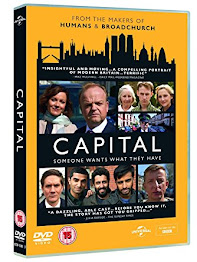
Real locations, everyday problems, The mystery of the stalker/postcards.
6) How does the factsheet analyse the DVD packaging and what this communicates to the audience?
He cover uses a grid of faces, which tells the audience it’s a multi-strand.
7) Look at page 5 of the factsheet. Choose one of the audience theories in the table and apply it to Capital.
Using Uses and Gratifications, an audience might watch for Surveillance.
8) What does the factsheet suggest regarding binary oppositions in Capital?
The factsheet highlights Rich vs. Poor.

Comments
Post a Comment